mona Intensive Care
Everything the unit measures, kept for the whole stay.
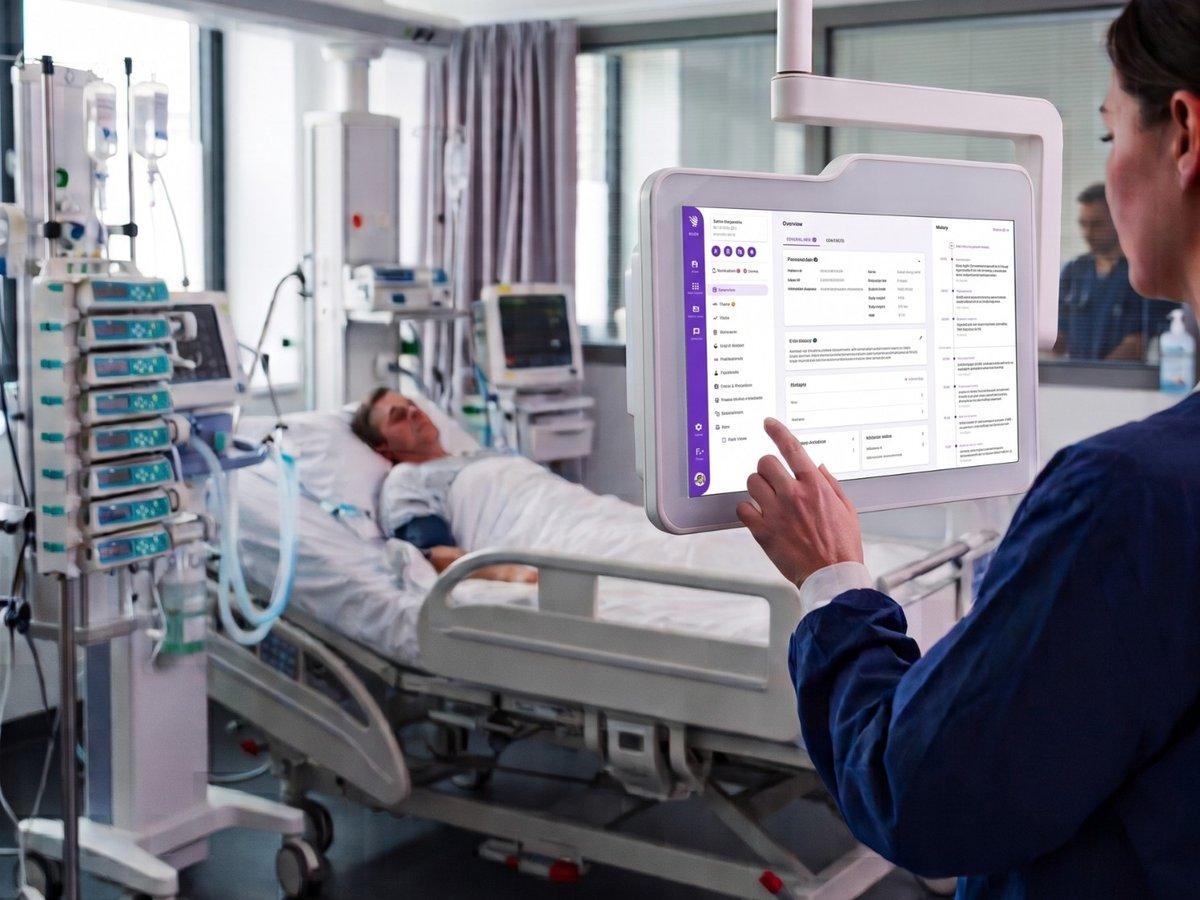
mona Intensive Care is the patient data management system for intensive care. Monitors, ventilators, analysers and the laboratory write into one stay timeline, and the team works in it from admission to discharge: on the mona Terminal at the bed, in the browser or on a tablet, on the Clinomic Cloud or in your own data centre.
- MDR Class IIa
- ISO 13485
- ISO/IEC 27001
- BSI C5 Type 2
- ICU beds served
- 350+
- Hospitals
- 45+
- Medical device types
- 200+

Mona significantly reduces the workload of nursing staff and doctors in intensive care by eliminating paper-based documentation, leaving much more time for patients.
Published study
Tested with 60 intensive care professionals against paper and an established electronic chart
8x fewer errors than paper
| System | Mean | Standard deviation |
|---|---|---|
| Mona, by voice | 0.28 | 0.52 |
| Established electronic chart | 0.75 | 0.88 |
| Paper | 2.37 | 1.46 |
2.5x faster than the electronic chart
| System | Mean | Standard deviation |
|---|---|---|
| Mona, by voice | 195 | 79 |
| Established electronic chart | 491 | 178 |
| Paper | 764 | 242 |
Randomised crossover study: 60 ICU nurses, physicians and students performed every task on all three systems. Peine et al., JMIR Medical Informatics. Read the study (opens in a new tab)
One shift on the unit
Twelve hours, five moments
A day shift on an intensive care unit, told through the record.
- 06:55ICU nurse
Handover
The night is already on the screen when the day shift arrives.
One click opens the patient, on day 3 with pneumonia: the history shows what happened overnight, and the icons in the patient menu show allergies, infections and therapy limitations on every page. Handover turns into a conversation about the patient.
- 07:30ICU nurse
Morning assessment
Standardised scoring is performed hands-on at the bedside.
The nurse assesses the patient directly: sedation depth, delirium indicators, and neurologic baseline are scored, timestamped, and visible in the view for the upcoming multidisciplinary round.
- 08:15Physician and nurse
The round
The round sets the plan, and it stays in view all day.
The team goes through the night: trends, laboratory values, the balance and the morning scores. Together they set the day's goals, which stay in the task list until the next morning, and adjust prescriptions from the unit's own sets. A change a nurse enters later stays highlighted until a physician confirms it.
- 14:00ICU nurse
The balance
The balance shows the distance to target, hour by hour.
The round asked for a negative balance by morning. Infusions and a unit of red cells with its batch number go in as inputs, urine and the drain as outputs, and the balance runs against the target hour by hour, so the team sees early whether the patient is on course.
- 19:00The whole team
Handover, again
The record the night shift inherits is the one the day shift worked in.
Nothing has to be typed up. The task list shows what was done and what is still open, and grouped tasks were documented in one step.
Connectivity
200+ medical device types, already connected
Monitors, ventilators, pumps, analysers and the admitting system, connected on your unit from the catalogue below.
How connectivity worksPatient monitors
Ventilators and anaesthesia
Haemodynamics and neuromonitoring
Infusion and nutrition
Dialysis and renal replacement
Diagnostics and point of care
Hospital information systems
FAQ
Questions intensive care teams ask first
Does mona Intensive Care replace the bedside monitor?
mona Intensive Care receives values from the connected devices and shows them in the record. It has no alarm functions and no measuring functions of its own, and it does not control any connected device. The monitors and ventilators remain the reference for real-time surveillance.
Which devices and hospital information systems connect?
200+ medical device types and the major hospital information systems connect, over HL7 and FHIR: monitors, ventilators, pumps and analysers, the system that admits the patient and the laboratory that reports. The integration starts with an inventory of what stands on your unit, and the connections are configured from there.
Can several people work in the same record at once?
Yes. Several users can work in the same patient record at the same time, at the bedside terminal and from other devices on the hospital network, and see each other's changes.
What do we work on at the bed and on the unit?
At the bed, on the mona Terminal, Clinomic's bedside terminal with touchscreen, badge login and dictation. Everywhere else, in the browser on the hospital's PCs and on tablets, in the same record.
Where does the data live, and who runs the platform?
Your choice. On the Clinomic Cloud, monaOS is operated around the clock by Clinomic's own DevOps team in European data centres and connected to the hospital over a controlled boundary. On-premise, the same platform runs in your own data centre, on infrastructure your IT operates. Clinomic is a certified medical device manufacturer and a certified medical cloud provider in one.
How does an integration on our unit start?
With an inventory: the monitors, ventilators, pumps and analysers on the unit, the hospital information system that admits the patient, the laboratory system that reports, and what each of them exposes. Connections are then configured, tested with your data and taken into use ward by ward.
See mona Intensive Care on your unit
Bring the questions of your unit: which monitors and ventilators stand at the beds, which hospital information system admits the patient, what has to reach the record. We prepare the session with people who have worked on an ICU.